
See what happened.
Follow model calls, tool use, outputs, latency, and cost across an agent's execution. Investigate the steps behind the result.
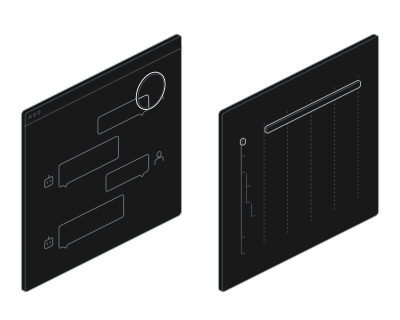
Structure
A step. A run. A conversation.
Span
One operation: a model call, a tool execution, a retrieval, or another instrumented step.
Trace
The connected spans belonging to one agent run or request.
Session
Related traces grouped into a continuing conversation or workflow.
Span kinds distinguish chains, agents, LLM calls, tools, retrieval, and embeddings. Use the hierarchy to inspect a specific operation without losing the surrounding execution.
Instrument
Connect at the level you need.
Framework integrations
Connect the SDK to a supported agent framework to capture its execution events and nested spans. Native coverage follows the framework's available hooks.
Framework guidesProvider wrappers
Wrap an existing model client to capture its calls, including supported streaming, token usage, and error details.
Provider guidesManual instrumentation
Use the SDK's explicit tracing interfaces for application logic, proprietary runtimes, and custom execution loops. Python also provides decorators and context managers.
Manual tracingIntegrations
Work with your existing stack.
Choose the guide for your framework, provider, and SDK language.
| Integration | Python | TypeScript |
|---|---|---|
| LangChain | ✓ Python | ✓ TypeScript |
| LangGraph | ✓ Python | ✓ TypeScript |
| DeepAgents | ✓ Python | ✓ TypeScript |
| OpenAI Agents SDK | ✓ Python | ✓ TypeScript |
| Claude Agent SDK | ✓ Python | ✓ TypeScript |
| Google ADK | ✓ Python | — |
| CrewAI | ✓ Python | — |
| Vercel AI | — | ✓ TypeScript |
| Custom execution loop | ✓ Python | ✓ TypeScript |
| Provider | Python | TypeScript |
|---|---|---|
| OpenAI | ✓ Python | ✓ TypeScript |
| Anthropic | ✓ Python | ✓ TypeScript |
| Google Gemini | ✓ Python | ✓ TypeScript |
| Mistral AI | ✓ Python | ✓ TypeScript |
| AWS Bedrock | ✓ Python | ✓ TypeScript |
| LiteLLM | ✓ Python | — |
Integration support is version- and capability-specific. Provider tracing does not by itself provide native Reflect checkpoints. See Reflect compatibility.
Feedback
From evidence to improvement.
Trace records what happened. Evaluate uses that evidence to check your agent's work against your criteria. Reflect brings failures back to your agent so it can propose reusable guidance.
Questions
Tracing, explained.
Do I need to rewrite my agent?
No. With just a few lines of code, you can connect a supported framework integration or provider wrapper, or add custom instrumentation around your application logic. The setup depends on your framework and SDK language.
Can I trace a custom agent?
Yes. Use manual instrumentation to capture custom application steps and connect them to the rest of the run.
Which providers are supported?
Majority of the harness building frameworks and model providers are supported. The agent framework guides and LLM provider guides describe supported capabilities.
How can we deploy PandaProbe?
Use managed Cloud, or discuss a paid Enterprise deployment in your VPC or on-premises. Community resources remain available for individual developers exploring the project.
Connect
Start with one execution.
Connect your agent and follow the work behind its next answer.
Building on your own? Explore PandaProbe Community, and contribute on GitHub. Explore Community →